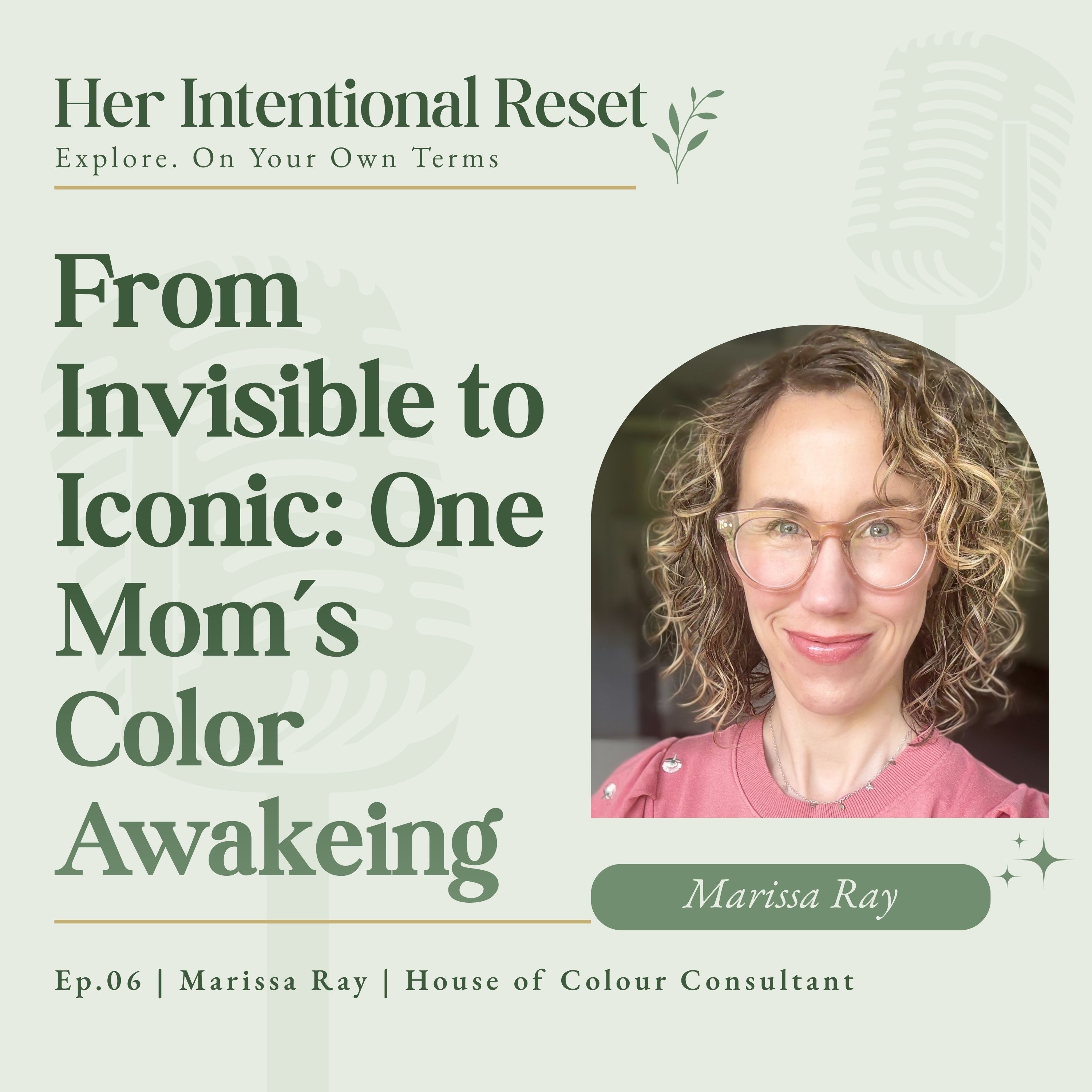
There is a moment when something finally feels like you — not the version of you that carpools and manages spreadsheets, but the version that has been waiting. Marissa found hers in a color drape. She didn’t blow up her life — she built a new one, slowly, intentionally, one client at a time, and she is here to show you exactly how she did it.
About Marissa Ray
Marissa Ray went from dental office manager and self-described introvert to House of Colour franchise owner with a waitlist and a TV segment — not by quitting her life overnight, but by saying yes to one small thing that brought her joy and following it with intention. She built a thriving business from a converted storage room — one client at a time — while raising three daughters and navigating an adult ADHD diagnosis. Marissa is a curator of confidence, a mentor to fellow consultants, and living proof that building slow and building intentionally is not a weakness — it is the strategy.
This conversation is a masterclass in building a part-time side gig into a full-time career pivot without burning down the life you already have.
WHAT YOU WILL LEARN:
WHAT YOU WILL LEARN
- [02:30] How Marissa reclaimed her identity and sense of self — and how that single spark became a career
- [27:00] What intentional, slow-build growth actually looks like — the real timeline, trade-offs, and mindset behind turning a part-time side gig into a full-time business
- [45:00] How an adult ADHD diagnosis reframed everything about the way Marissa runs her business — and why self-awareness is a superpower, not a setback
- [01:01:00] How to learn to sell without feeling salesy — and why believing in your own value is the skill that unlocks everything else
- [01:08:00] The Profit First method in practice: how Marissa pays herself first, gives intentionally, and builds a business that funds the life she actually wants
GUEST OFFER:
If you’re interested in finding your own colors and style, book an appointment. Come see me or find a consultant near you because there may be other stylists in your area. View all House of Colour stylists here: houseofcolour.com/find-consultant
If you think this could be a career fit for you, reach out.
If this episode resonated with you, subscribe on your preferred streaming platform and share it with one woman who needs to hear it. Every subscribe and every share helps this community grow.
GUEST RESOURCES
Books:
- Profit First by Mike Michalowicz — The small business financial system Marissa uses to pay herself first and manage cash flow intentionally
- The Total Money Makeover / Financial Peace by Dave Ramsey — The debt-free philosophy behind Marissa’s family money decisions and college savings strategy
- When: The Scientific Secrets of Perfect Timing by Daniel Pink — The book that changed how Marissa structures her entire workday and week around energy peaks and lulls
- Remarkably Bright Creatures by Shelby Van Pelt — Marissa’s favorite recent fiction read (and soon to be a movie)
- It Sounds Like Love by Ashley Poston — A romcom Marissa says stuck with her long after the last page
Podcasts:
- The Lazy Genius Podcast by Kendra Adachi — Marissa’s life-changing recommendation, and the source of the infamous “Change Your Life Chicken” recipe
GUEST LINKS
Facebook Page URL: @houseofcolour.minneapolis.sw
Instagram Username: @houseofcolour.minneapolis.sw
LinkedIn Profile URL: @houseofcolour-minneapolis-sw
Website:houseofcolour.com/marissaray
You can also note that there are consultants across the US and can be found here houseofcolour.com/find-consultant
CONNECT WITH HIR
- Instagram @herintentionalreset.co
- Facebook @Her Intentional Reset.co
- Website:www.herintentionalreset.com
If HIR has been valuable to you, you can support the show here: Kofi Support The Show
- No pressure — just making it easy for listeners who want to say so.
Music from #Uppbeat (free for Creators!):
- https://uppbeat.io/t/hemlock/the-way-forward
- License code: RVGOVVHKDJFBKVJC
Transcript
Pre-Roll
I had been for a couple of years saying everyone else has a passion. And, I just felt like so many of the people, like my close people had a passion and I didn't have a passion.
And after about a year, My best friend was like, you found your passion. I didn't realize it at the time, but that was my driving force, is that I had found something that felt very true and authentic to me, and
I wanted to dig into it. I wanted to see where I could really take this. It was the first time I think I truly believed in myself, even though it was just gonna be a side gig. I could do this.
Meet Marissa
Hi there. This is Her Intentional Reset, a podcast for women in midlife. Curious about whether the career they chose 20 years ago still fits. Hear from women who have made pivots big and small, discuss the practical realities, the trade-offs, and whether the change was worth it. I'm your host, Molly Wipperfurth, and I wanna thank you for joining.
If you're new here, welcome. I'm glad you found us, and between episodes, join us on Instagram or Facebook at Her Intentional Reset dot co co for guest behind the scenes and what's coming next.
Now let's get into today's conversation.
Meet Marissa Ray, House of Colour consultant in St. Louis Park, Minnesota. Marissa is a self-described curator of confidence through the science of color and the art of style analysis she helps her clients rediscover their natural beauty and helps them build a wardrobe that actually honors it. A Minnesota girl at heart with a brief detour to Madison where she met her husband, she's now happily settled in St. Louis Park. Between raising three girls, wrangling two dogs, and surviving all the chaos of owning a small business. Marissa knows that life is busy, but looking good should be the easy part. You can usually find her wearing her favorite shade of purple, singing along to worship music, or dreaming of her mountain getaway. I'm so glad to have Marissa here. This is Her Intentional Reset.
Intro
Hi Marissa,
Hi.
so great to have you on. I have to start by telling listeners that I've actually been one of your clients You are so good at what you do, which is why I asked you to be on this show and share your incredible story.
But before you were front and center in the business of making people feel good, you were behind the scenes making a business look good. So take us back. What were you doing before? House of Colour.
From Dental Office to Color
Yeah, I was an office manager for a small dental office. I actually worked for my mom, like coming up on 20 years at this point. I have always loved to say that I am a numbers person. I am very strong in administration and kind of making things work well behind the scenes, and I thought I would do that forever.
Okay, so how were you introduced to House of Colour then?
I was in a mom's group, when my kids were younger and one of our speakers was a House of Colour consultant and she came and told us what it means to have your colors done, to have your style analyzed and why it matters. And I was just, it's like this light bulb went off for me and I thought I need to do that. I love color. I've always loved color. I used to wear bright red sneakers in high school and I had just let myself get really dull, black, white,
gray, or whatever my sister wore, I would buy from her when she was done with it. 'cause she was very trendy. And I didn't have my own identity. I didn't know how to get dressed.
I didn't know how to wear makeup. I was just feeling kind of invisible in my own skin and I didn't know
why. I didn't enjoy getting dressed every day.
Yeah.
Feeling Invisible as Mom
What was going on for you at that point? What do you think it was?
Oh well, three kids full-time job. A husband that had a very demanding job. he works in city government and his job is basically 24 7. so I took a backseat
and I just kinda let things happen and let other things take the priority. my youngest was two when I had my colors done.
And it was kind of that we knew she was the last one. And, I was like, this is my turn. This is my time to find what works
for me.
Saving Up for the Consult
And so, having your colors done, having your style analyzed is an investment for some people. we were living on a budget and I saved up.
I just told myself, I'm gonna
set aside this much every month until I get to my consult, and then I get to have it done. My world opened. I was like, I can wear color and I know how to wear color. And
I started getting compliments left and right and you know, like,
oh wow, your skin looks great today.
that color's amazing on you. it was like I started to get excited about getting dressed because I knew what to wear, I knew how to feel good about myself.
Yes.when exactly was that light bulb moment? Tell us more about that.
The Lightbulb Moment
was after my colors were done. I was wearing my sister's hand-me-downs all the time,
and she came along to my appointment. She's younger than me and she was sitting across from me, like watching the colors change me. And I remember she goes, oh, I see your bags. I don't see your bags.
I see your bags. I don't see your bags. And I was like, thank you, that's helpful, but you show up with no makeup. And sure enough, I was like, oh my gosh. Like I don't notice my bags as much. I don't notice the discoloration underneath my eyes and I'm not wearing any makeup. so the fact that she could see it, I was like okay. That was
the light bulb moment, was seeing the difference that the colors made on me and hearing someone reinforce it for me.
And then you said then afterwards you were getting compliments. Once you were implementing
what matched your colors? So then where was that shift from? I feel great to, I wanna be a part of this business. Walk us through what that looked like for you.
Considering the Franchise
It was a two year process actually. so I used to say that to my clients, like once I was a House of Colour consultant, they would be referred by someone and they were like, my friend couldn't stop talking about it. And I used to say, yeah, it's kind of like joining a cult, like you want everyone else in it?
so it's like joining the sorority that sounds a little bit more appealing. but it really was, it's like I could not stop telling people about it. And I kept telling people that they should go see. The person that I saw at the time, there were only three consultants in the Twin Cities, so they needed to go see and have their colors done. And I would go along to some of the appointments, like if it was a family member, and I would talk all about how much I loved it and why it mattered and how I was, you know, all in, or, oh, I went shopping and I found these colors. And I remember she said to me, you know, you could do this too. Like, you have the ability, you have the excitement for it.
You could do this. And I thought, ah, okay. Yeah, I could. I think that was probably a year and a half after I had my colors done
Oh,
So it had been a while.
I was like, okay, well let's see. We're a franchise organization, so I applied for a franchise pack just to get information. What would it, what does it mean, what does it look like? you get that information, you read through it, and then you ask to set up an interview with their person at the time.
Finding a Studio Space
And the biggest hangup for me was that almost all, if not all of the consultants who did it when I started, they saw their clients in their home and we did not have an extra bedroom in our home.
And I thought, how do I keep three children quiet while I'm trying to see clients? so that was also kind of some of the delay was just like, ah, I just, I don't know how I do this and
how do I find space? And I kept talking about it and kind of mulling it around and. Saying that I was interested, but I just didn't know how it would work
with our schedule, our space. And, my mom owns the dental office and owns the building that the dental office is in, and there was a storage room that was all of her storage stuff. And she was
like you keep talking about this. If you want, you could take that room and you have to fix it up. You're gonna have to paint it and, get it all clean, but then you can have that as your studio. And that was kind of the flip where it was like, oh, okay, like, now I have a space where I could possibly do this.
and then I was like, yeah, let's get our interview on the calendar. And
so I interviewed in April.
I was actually on vacation with my entire family, all of the nieces and nephews. And I went and I sat in the jacuzzi tub in our hotel room. ' cause that was the
quiet
Taking the without the water. Okay. Without, okay. I was like, wow.
No,
I, I want in on that type of
No,
It was the quietest place in the condo. it had good lighting it also had a decent background.
You are clothed and all
yeah.
Sorry. this is a G rated podcast right?
Yeah. So, so then what happened after,
Interviews and Territor
that interview?
I met with, the head of the company, like the CEO over in the uk. She wasn't called the CEO, but she was the CEO over in the uk. and she is pretty intense and I remember thinking like, oh, she's not gonna give this to me. I had to submit a picture with my application and I submitted a picture and then like right before I went on vacation, I cut off eight inches of my hair and she was the first thing, she was like, hello, you got a haircut? And I was like,
I don't know you, but yes I did. And I'm like, Ugh, was I not allowed to cut my hair? so I was thinking like, oh, she's gonna think that I'm not right for the job. I've always had an issue with, imposter syndrome, but. she said, let's talk about zip code, you talk about the process and what that means.
And then, if you decide to go forward with it, you sign a non-disclosure. You say yes, I'm ready to move forward. We're a franchise organization, and so, you have a territory that you own. I got to pick my zip codes and sign a contract and put money down. Then you start talking about training. So I interviewed in April. I actually went to training in June, so it was some time to get everything set up.
During that time, as you're talking to her, she sounds a little cold or a little,
So just very very, like get to the point
so then
Imposter Syndrome and Commitment
when you're thinking like, ugh, this may not be feeling the right way, or that imposter syndrome is coming up, , how are you feeling about the thought of maybe not moving forward with this.
I think that I was worried that this would be just another one of my ideas. I have recently been diagnosed with A DHD, and so I understand a lot more why I would like dive all into something. I mean, I thought I was gonna be a wedding photographer. I photographed one wedding as an assistant. That's it. there were other things that I thought I was going to, like, I was all in. And so I was worried that this would feel like that, that like, I had done
all this work and got everything set up. it was when I. Had to go to the bank and talk about getting a personal loan to make my initial payment to buy the
franchise that I was like, no, I'm, I have to be all in on this.
I'm like, Yeah. I think I am all in on it. I'm ready.
My best friend at the time had said, actually a year after I started, she was like, this is your passion. But at the time, I had been for a couple of years saying everyone else has a passion. You know, like my husband Mark is. He's like, he's got his job, but then he has these side gigs that he's so passionate about and he's all in on them.
And, I just felt like so many of the people, like my close people had a passion and I didn't have a passion. And after about a year, she was like, you found your passion. So I think that, I didn't realize it at the time, but that was my driving force, is that I had found something that felt very true and authentic to me, and
I wanted to dig into it. I wanted to see where I could really take this. It was the first time I think I truly believed in myself, even though it was just gonna be a side gig.
do this. I could do this,
So there's a lot to unpack there. I do
Family Money Talk
wanna talk about your A DHD diagnosis, but first before you decide to forward with this franchise What did that family discussion with your husband look like for you two? Because there was an investment that you had to put in,
Mm-hmm. Yeah. we had some really hard conversations. I think he would tell
you that if you asked him to. he made a comment and I think it was probably. Too late at night. I mean, I, I definitely believe you shouldn't have difficult conversations after like 9 45. and he was like, what if we have to file for bankruptcy?
And I was like, I don't think it'll be that. Right. Like the investment, it was not that large. It wasn't like a year's worth of our salary or anything. but it was like, no, I think we'll be good. I think we'll be fine. But it did make me think, I have to make this work. ' cause this is not just my money on the table. It's our money. It's our family's money. and not just money. There's time too. I mean,
my girls at the time were four. 10 and 12. And so there is something there as well.
that they had to make a sacrifice and we all had to agree to it.
I don't know that if they had said, no, mom, I don't want you to do it if I still wouldn't have done it. But I think just saying like, Hey, mom's gonna do something for herself now, and mom's gonna have to do some travel.
Mom's gonna have her own space and we're gonna have to let mom do this job. And there might be times where she can't just be available to us.
was the financial investment the heaviest decision?
Yes. That was the heaviest, almost equal, was the fact that I consider myself an introvert and the idea that I had to go sell myself to get people in the door, I didn't like
okay. So then what made you keep moving forward with this ?
I kept moving forward because I knew that it changed my life It feels crazy to say like, oh, having my colors done changed my life. But it really helped me to see myself in a whole new light and see myself as beautiful and see myself as confident and, want to show up and not be afraid of being in pictures. I just felt like, oh, I'm a grownup now. Like I can be a grownup. I think that was a huge thing that kept me going, just knowing that I was going to be able to provide that for other people. it was kind of the fire for me.
Yes.
And showing my girls that I was choosing to do something that was kind of against the norm. that halfway, not even halfway through a career, but in, what I thought was going to be my career for my lifetime.
Kind Back office management, stuff like that maybe I could do something different or just an
add-on. Right? Like all of
this, I was thinking I was just gonna do a part-time gig.
It was just to earn a little extra money.
Wow, what you said is so powerful right there in so many aspects because you get dressed every single day and what happens when you feel beautiful, like how that comes about in your day to day, in your interactions with the people that you're with. What gave me goosebumps is when you like you didn't like to be in pictures.
And I'm like, how many women do we know that they're never in their pictures.
They're always taking the pictures. Yes. So I just wanna sit in that moment with what you said, and I think that's really powerful about, what this meant to you. And thank you for sharing that. And I think a lot of us can resonate with what you were saying.
so you weregonna start this part-time
Starting Part Time Hustle
only. How long did you do that? And when did the switch?
a long time,
I worked at the dental office Monday through Thursday . And then we were open every other Friday. And so on the Fridays we weren't open. I would open it up for clients then Saturdays if a client wanted it, Sundays, if a client wanted it.
Because I started in the summer, I was able to see clients in the evenings. color requires natural light. And basically if someone asked me, I was gonna find a way to get them in., I don't do that anymore, but I wanted to grow my business. First few months I saw four, five clients over the span of a month. Like it was slow. I knew it was gonna be slow. It was mostly people that I knew or friends of friends, family members.
Training Then COVID Hits
tyle training for February of:what did you do during COVID?
Great question.
Pivoting During Lockdown
Corporate team did allow us to do style virtually to see clients on Zoom. I did some wardrobe edit workshops, right, like basically trying to think outside the box of howto continue to connect with clients and bring in some revenue when I'm not allowed to see them in the chair in the studio.
That summer I hosted an outdoor color day and we set up on my patio ' cause it was outside. We tried to be really creative, but it also forced me because the dental office also shut down. So I had this time that I did a lot of reading, I got into a mastermind with a few other consultants and we would meet weekly about what's a strength? What's a weakness from the past week? What's an area we need to work through? And I really flipped my mindset on how to sell myself, on the idea that like I'm not selling to make money, I'm selling to help people.
And it's okay to say this has value and it's worth paying me to give you that value. It was a good blessing to have that time, as hard as it was to not be able to see clients in person. But I think if I hadn't had that, I don't know if I would've still been here.
I really grew in my business confidence and my business ownership and not just being the office manager for an already existing business, but like making it my own, taking responsibility and being there for my clients.
Yes, there's this saying that sometimes you need to go slow to go fast.
Growth and TV Breakthrough
So at what point then, after COVID, you started considering leaving the dental business
behind, It was summer of 23 that I started to get really busy, to a point where I was able to take Wednesdays off at the dental office. I said, I just want one day. And that was supposed to be my administrative day and my appointments day but I kept putting clients in there 'cause I just wanted to accommodate people. also twin Cities Live asked me to do a segment about color analysis because during CIDI started conversations with various local public figures. Then one of the producers said, I really wanna get my colors done.
Has anyone ever heard of it? And because I had had these conversations with the host, she was like, oh yeah, you should talk to Marissa. So the producer came and
had our colors done and we recorded some of that session. And then I went into the studio and we aired some of the session.
And all of a sudden the calls just kept coming in. And it was like, I saw you on Twin Cities Live. I saw you on Twin Cities Live. I've been thinking about doing this. I saw you on Twin Cities Live. And that's one of those because I started a conversation during COVID VID with someone that I didn't know, but I was brave and Iasked her a question and then we kept going back and forth. It got me this opportunity to share my story and share what I do. And so I ended up getting a wait list. I had so many people that wanted to come in and I just didn't have the ability to accommodate them. and that was when I started to think, could I do this more?
Like, could I actually do this more? And things were shifting at the dental office and I just, I got to the point where I was like, I wanna see what I can do. I wanna see if I believe in myself.
Leaving Mom's Office Mostly
So December of 23, I said to my mom, which is really hard when your mom is your boss and, you've been telling her all along, I don't think I'm ever gonna do this full time. I probably shouldn't have said that. Um, uhhuh? you never know what the future holds. And I said, I think it's for me to give House of Colour more of my time and more of my attention, and I will give you six months notice. So I gave her a lot of runway.
What was her response?
It was tough, it was a tough conversation, I think just because we had had such a connection and we had spent so much time together in the office and
she would say that I'm kind of her person. I think that was also like, well now I have to do this without you.
And I'm like, yes, I get that. I still work there one day a week, so I did not leave completely.
Are you there because of family obligation?
Yes and no. I'm an Enneagram six, I'm a loyalist, like almost to a fault. But also so much of the way the office is, I grew, I learned, I trial and error. I wrote our office manual. I did so much that I felt like the idea to walk away from that was kind of like but this is my baby.
ADHD DIagnosis, Systems, Self Management
Besides the wait list, what needed to be true for you to say like, okay, I really, want to see what else can happen.
I had gotten to the point where I did believe in myself that people would come, that it would continue to make me money. you didn't have to worry about being. Like, people won't come to me. And as with any business, there's ebbs and flows in the business. February is generally a slow month, and September is generally a slow month, but I had had enough years in the business even doing it part-time that I had figured out ways to survive those months or use those months more intentionally, even if it wasn't a client in the chair. And so I felt like I had some good systems in place and knowledge that was preparing me for the long haul. The thing that I didn't realize that I, I thought I was really good, like with deadlines and I thought I was really organized and systems and procedures and all of that. I didn't realize is when I was the one holding myself accountable to those deadlines and those systems and procedures, this was before my A DHD diagnosis I just wouldn't do them. I did not know that going into it. And it has been a journey to learn how to be my own boss and to keep my business successful and focus my attention appropriately where it needs to go.
You've been very open about getting diagnosed with A DHD. Can you walk us through that when you had the deadlines, you met the deadlines, but then what else was happening?
In House of Colour I was seeing myself get lost in a project. Just think, oh, okay, I'm gonna spend an hour on this, and five hours later I would be like, oh my gosh, my day is gone. What did I do with all of that time? And do I have anything to show for it? Not really. I would create These like very detailed systems and organization. Um, social media is a really good example. I had a whole plan and slides and they had six different posts and they had to go in this order, and I had a whole collection of ideas and I would take a picture every day and I would follow all these different accounts so that I would get ideas from them, and then I wouldn't do anything and I'm like, but I've got all the ideas and I've got the resources, and I've got, got my plan, I know what I have to do. And it would be like analysis paralysis. I would just sit there with all of this information and not even know where to start. And I started to kind of feel like something was wrong with me, right?
Like, how could I do such a good job in the dental office and be successful with my time and, putting all of these systems and procedures in place, and then I couldn't even do it for myself and I really started to question my ability, and I was still getting clients in the chair and I was still wowing them,
but the minute they walked out the door, it was like, how do I get all of the follow up to them? How do I, act as a support or a guide in their confidence journey when I can't even guide myself in this business journey? Or I felt like I was dropping the ball on everything. , I just kept feeling like, oh my gosh, I've got so many things and I, I was drowning
So what happened next?
Three different people close to me, start conversations with me about a DHD. One in her forties, one in her thirties, recently diagnosed with A DHD and just kind of starting to talk about and very successful in what they did. And I was like, huh, okay. Like, they're not hyperactive. They're not what we think of as. that like buzzing around the room and they won't sit still. And I was like, okay. Hmm. So they're really successful and they still have it. And then, some conversations with other people who are going through an investigation for their children.
What that looked like and what that meant. And also, to the algorithms of Google and Facebook and Instagram, I started getting information about A DHD and I was like, huh. That sounds like me. so finally I did this online assessment, it's with someone who's licensed. It took me about an hour and a half
And it was not just looking at ADHD, it was looking at depression and OCD and anxiety and all sorts of different things that we can deal with. And it was yeah, you have the markers of ADHD. so there's two different types. One is the hyperactivity, one is the hyperfocused, and I'm much more the hyperfocused.
This is so clarifying and makes so much sense. I'm not gonna use it as an excuse, but it helps me understand that I have to approach running a business very differently than someone who doesn't have my brain.
So what have you done or what's changed for you since finding that out?
A big part of it was starting to read, read about it, understand specifically from the perspective of a woman like how we can appear to be very, put together and very organized,
we try to rely on those systems. And so giving yourself permission to set up a system that's gonna work for you and that's gonna be very different than someone else. That has helped. And giving myself permission to abandon a system that's not working.
It may have worked for a
time, but it stops working, which I find entertaining because I tell people that in style a lot, that like, this might be a 10 out of 10 for a season and then you put it back on and nothing about it changed, but it's no longer a 10 outta 10, it's okay to abandon it, it's okay to walk away. And so some of it was also like a little
bit of self preaching you know, like this is what I tell people about their clothes. Right. Like, believe it yourself when it comes to your business.
I found a doctor that kind of helped me figure out the appropriate medication for me and, just giving myself grace. That was the biggest thing, is I don't wanna use it as an excuse, but understanding that It's the way that my brain is wired and that there will be times where it's hard and it will be hard for me to kind of push through,
so then I can be okay doing the bare minimum and not beat myself up for it.
Thank you for sharing that. By you sharing the self-assessment you never know who's listening and they may recognize some of those same traits in themselves. I found it really fascinating after our conversation previously that a lot more women than men get the diagnosis later in life. And it's so missed when women are younger. And part of that it may be because, we are kind of conditioned to be good students, be quiet and listen to our adults. And I see how it gets masked when I saw the statistics on how prevalent it is for women over men.
A Week in Her Business
Give us a picture of what does a given week look like for you.
now
I knew that I needed a day that was dedicated to admin. I don't transition between things well, so if I have one client in the morning and I'm supposed to do admin in the afternoon, that can be really tricky for me to flip my brain in how I look at the situation. Monday is my administrative day and I reserve that day to look at my financials to, follow-ups for clients or maybe plan for social media.
I work at the dental office on Tuesdays And then I see clients Wednesday, Thursday, Friday during the day. And every school year, really, every semester I at our schedule and arrange my clients accordingly. So I don't like to leave before my kids leave. And my girls are older now. I mean, they're 17, 15, and 11. The 11-year-old is in elementary school and goes to school really early. But the the other two can get themselves out the door to school, but I just don't like to leave if I don't have to. And on the days when she's home after school, I wanna be home with her. I will still do House of Colour administrative stuff when I'm there with her. But thanks to the wait list and the ability
Weekend Scheduling Strategy
to, design my schedule accordingly.
I am more picky about when I see people and you might just have to wait to see me, and that's okay. So that's Wednesday, Thursday, Friday, and then on Saturdays, my girls are all dancers. They dance on Saturday mornings and I open up my schedule on the days that they're dancing, and Saturdays are really desirable for people.
So I also want to be available on Saturdays. There are some consultants that just plain don't see clients on Saturdays, and I do think that that's one thing that has helped my business in that I do have some flexibility.
Isn't it great that you have that flexibility and freedom to prioritize your
family, prioritize being with your kids. Kudos for you to be able to shape that the way that it works for your family.
Practical Considerations
Learning Sales and Social
Shifting gears to the practical considerations. You were running the dental office, so you had some of that business acumen that you brought to the table when you started this. What were the other skills that you had to learn
I had to learn how to teach people to put on makeup, which I still laugh about today because like I was the person be like, I should probably go wear makeup. And then I would go like, do I go to Clinique or I go to Mac? Okay, I'll go to Mac, you know, and they would do my whole face and it was gonna take me 20 minutes to do and it did not feel like me at all. But I'll be like, I'll buy it all. And then a week later I'd be like, ah, and two years later I'd throw it away. So that was, a really a big eye-opener.
And then to sell it right. We have our own line of
cosmetics and it's really good makeup. Um, but to believe that people should buy it from me instead of trying to go and find their own at Target, like it, I had to teach myselfhow to sell and not sell in a pushy way or a salesy way, but sell because it did have a value. I
had to teach myself how to sell my services and encourage referrals and ask for referrals.
knew I had the, business mindset to set up my financials properly, and I actually knew how to register my business with the Secretary of State. I knew how to get a sales tax, like a Minnesota ID number. I knew how to pay my sales tax. I knew how frequently I had to pay my sales tax 'cause I did it for the dental office. But it was the selling and the putting myself out there.
You
House of Colour Investment
talked about the personal loan that you had to take out what was the actual investment to start with House
of
Oh yeah. I will tell you that if anyone listening goes and requests a franchise pack, they will see a much higher number than when I invested. House of Colour has been around for more than 40 years in the uk. Our first, US consultant came over.
I went to training in June of:So we have grown tremendously in,almost seven years. But because of that, the investment is a lot higher. I paid 10,500 for my first payment and I had to pay that before I could go to color training. And then I had to pay the remaining 3,500 to go to style training. That was my training fee and my, purchase of the franchise. The ownership of the territory,
Is it a requirement that you need studio space now, or are some people still doing it out of their home
I would actually
say that only about a quarter of us do it out of a studio space. Some people have teams, so they have multiple people that work together in a territory. They have bigger studio spaces, so they have almost like hairstylist workstations.
I bet two thirds to three-fourths still have their studios in their homes.
Okay. It's reasonable. I think I think now it's 26,000 and that includes your training, and then purchasing the franchise. you can come on as someone's associate, so
it used to be that you had to live in that territory. I own St. Louis Park, Southwest Minneapolis and Edina. And if someone say, lived in Edina and wanted to be a consultant and applied for a franchise pack, they weren't allowed to buy a franchise because I own already owned the zip codes they lived in. But they could go through training, they could pay for their own training, half of that 26,000 now. And they could operate their own House of Colour business under my umbrella. They would have their own business. and they would
pay me like a rental fee, basically, kind of a franchise usage fee to be able to do their own business in my territory.
Right.
Okay. Thanks for giving us that peek behind the curtain
Profit First Pay Yourself
You have a great philosophy on how you pay yourself
Can you walk us through what that is?
Yes. I read a book called Profit First. the idea primarily for small businesses is that so many times, the money comes in and it goes right back out to pay expenses, to pay
dues to pay employees, and you get to the end and there's no money left for the owner. We can flip the switch or flip the mindset and set aside money for the owner first, then you're more intentional about how you use the money that's left over. Because we know that there will be slower months, there will be higher months. And so we have to be more thoughtful about that. So in book, he recommends looking at your finances on the 15th and the 30th, Now that's too random, which sounds funny, but that's too random. I like a week cycle. That seems to work really well for me. every Monday I log into my bank account and I look at how much money was deposited based on people who have booked appointments, makeup that was purchased, personal shopping, commissions that I've done, stuff like that. and then I, pay myself. And then I divvy up the rest of the money. I set money aside for taxes. I pay a monthly royalty and technology fee to headquarters
I am really intentional about giving a portion of everything that I make to charities, and I specifically choose local charities that are kind of similar to me. I've looked at single moms, right? there's an amazing charity that does something for that, or
like local community, and So a percentage goes into an account for that.
and so you pay yourself as the owner, but then you're also supposed to set aside a percentage for profit
He would say like, even start with 2%, right? Like if you think you have no money, start with 2% and then every three months you reevaluate percentages and whatever's left goes to expenses.
like right now, I would love to get another client chair in my studio and it's not that much, it's like
150, but I've had some slow months and I will not be getting that chair until I have a little extra in the expenses fund. It just
makes you think differently about like, is that really an expense? Is that really money that I need to spend?
Right.
you are giving yourself the money first, and then whatever's left, then you can spend it.
I think that is so insightful. we'll make sure to post that, book and the author in our show links. Thanks for sharing that philosophy, and it's great to hear how you're implementing that in practice.
College Money Philosophy
Give us your philosophy on your kids' college. Like what's your approach with
that?
We did Financial Peace a while ago. If you're not familiar with that,
I think the tagline is live like no one else, so you can live like no one else and it's being debt free and thinking about your money differently. Not chasing, you know, not trying to keep up with the Joneses. And, one of the things he talks about is you should save for retirement before you save for college. And so we very intentionally made a choice that we would rather save more aggressively for retirement, knowing that you can borrow for college. Not that I want to borrow, but like if we had to borrow, we could borrow for college.
And we started from a very early age about talking to the girls about responsibility and that when they make money. Half of what they make goes into an account. So if they were babysitting, if they had a lemonade stand, my older two, are like assistant dance teachers. Half of what they make goes into an account and it's not a lot, they don't but it is just starting a little bit And they know that they're gonna have to pay for half of college wherever they go.
I don't wanna keep them from going to college, I just want them to have a little skin in the game whatever they make scholarship wise comes off of their half. And if they get a full ride, oh, I'm not giving them two years worth of college in money. They just get a full ride.
it's also a blend of, you're essentially teaching them, like pay themselves first as well too, and invest in themselves you're teaching them young to put that money aside for themselves, for their future.
what a great gift in financial discipline, that you're teaching a, at a, young age that's gonna be ingrained in them as they
and I should say it sounds really good on here, but it doesn't always work. And they don't love it sometimes, and they still spend
all of their money on KPop and then tell me can I have whatever to go with friends? So it's a process. Nothing ever works out perfectly.
I hear you. But you know what, If you can achieve that 80% of the time,isn't that what we're all striving for progress over perfection?
Yeah. Yes.
Confidence Impact on Kids
With this franchise,
you were very intentional with starting slow, starting part-time and then being able to grow into a very successful business that it is. Now. Looking at this big picture, how has this change affected your happiness and
your family's happiness?
my girls see me. they like telling their friends about what I do. my oldest daughter is in Deca, the like business for high schoolers,she went to state And my daughter's a spring and Mia got to wear this adorable peach blazer and this like bright navy kind of like dress. she looked fabulous up on the stage she actually won state in her category, and we have a video of state, it's like black. gray, black mia,
Oh,
she's like, I know that I was able to show up and I was memorable because I stood out And I am not the color police. Right? If you wanna wear black, fine, but they have seen how the colors and the style matter and they get to be very true to themselves.
I give them permission to be true to themselves and to know that what might look good on someone else might not look good on you. And there's nothing wrong with your body. It's, it's a problem with the clothes, right? That was not designed for you and therefore we're gonna find something else. And so I think, they have seen me be more confident and because of that, they have permission to be more confident in who they are and not try to follow the crowd.
They also, think I'm a little bit of like a minor celebrity. I say this because like, we went to a Timberwolves game together I was putting on some of my lipstick and she
Mm-hmm.
a picture of it and she's like, look at my mom putting on her lipstick
And she tagged me in it and her friend was like, wait, your mom is the color lady.
The color
lady.
I was like, yes.
but I think that's been kind of fun for them to be like, oh, people know you, like you are your own person and you, are doing really well.
That's awesome. Thank you for sharing. And you know what, it's one of those, like, if they follow in your footsteps, like what great
footsteps to follow.
I sure hope so.
So what's
Hiring an Associate Next
next for you? In House of Colour? Hmm, I would love
for someone who wants to be a color consultant to come and be an associate on my team. Not because I have a crazy wait list don't have that crazy wait list anymore, I'm kind of isolated in that it's just me and I want someone else to collaborate with. I want someone to kind of come alongside me and run their own business and see their own clients. You come on board and there's no guarantee that I'm gonna fill your schedule, but
this service sells itself if you wow your clients. You don't have to worry about it. And do think we have a lot more brand recognition now, and because of that, it gets more people in the door. I would love to have an associate. And we're a franchise organization, but we also have a rewards structure and all of that and so when there are two people coming together, we get to the rewards faster
So lots of growth on the horizon
Keys to Her Success
Looking back on your journey, what do you think are a couple of the strengths that you have brought to the table that's helped you be so successful
it's interesting. I just had someone tell me this yesterday and I was like, really? You see that about me? but she said. You are consistent when you decide to show up for people. And I, I'm very real about my struggles, about my frustrations, about things that work, about things that don't work. I think I'm also very honest to be like, this is what worked for me, but it might not work for you. And because of that, I have kind of, um, a little bit of like a self-proclaimed mentor for newer consultants I will make friendships with them and then they'll start asking me questions and I'll be like, I'm here for you. Like, I'm happy to be here for you. so one of these friends was like, you're just consistent.
I know that when I need you, you're there and I know that you're going to give me a thoughtful responsewhen I need that. I think that's really important. I hope clients would say I'm, consistent. I'm also loyal
to the ideals. we say that At House of Colour we're curators of confidence and celebrators of individuality and. I believe that I really, I do both of those. I help people find confidence in themselves and I help them see that they were, beautifully and wonderfully made exactly the way that they are. And I just want them to have like a new set of glasses And I mean, I will admit I do Botox, so I can't say I won't tell you to do Botox. cause I really like that I don't have my 11 angry lines. but you don't have to have plastic surgery and you don't have to get a tan and you don't, you don't have to get a whole new wardrobe.
let's just do it differently. Just look at ourselves as beautiful.
I love that. when you said the word consistent and you mentioned you hope your clients feel that too. I automatically in my mind was like, oh yeah, I completely agree with that. I've known you for several years now and you make me feel like the most important person, sitting next to you.
I was not planning on adding my 2 cents, but I felt the need.
I also wanna say how we see ourselves is sometimes different than how others see us. And most of the time we, especially as women, undersell our strengths or we don't see all of our strengths.
Joyful Client Testimonials
And so I want to share what your friend Jody Ward Rena had to say. from Jody Marissa's superpower is how she helps her clients find joy, confidence, and pride in themselves. Marissa and I are friends, and often when we are chatting, her clients will come up to us beaming to tell Marissa about the compliments they received that day about their color choice or style.
People who send her photos and messages always have this radiant smile on their face. They're proud and confident, but more than that, they're exuding joy. I think Marissa is successful because she helps people feel that. And when you feel like that, you want people you care about to feel that way too.
I also use the word intentionally. Marissa constantly tells people she isn't the color police. Her superpower is that she helps you figure out what's best for you. She provides unwavering support with her business and with her friends and family.
She's also kind, trustworthy, loyal, funny, and all of those things make her an amazing friend. For an example of joy, jumping off the page, check out Marissa's recent posts about her daughter's Deca win too.
Yes.
What does that bring up for you
I started to tear up hearing that because it just means that it's working. I try not to be a prideful person. when I mentor other consultants, sometimes I'm almost a little bit sheepish when I tell them the numbers that I bring in every month or every week.
And, we're talking through kind of the business side of things because I don't want them to feel like they're a failure if they don't bring in those numbers. But for me. It's, you can't measure joy, you can't record it, you can't rate
it. And, if I don't rank in the company, if I don't have a good month,when I know that my clients are feeling good about themselves and they have that joy and that has come from me, that is like the greatest reward. It just feels so
amazing.
Yes.
I'm so glad that you took a chance on yourself all those years ago.
Rapid Fire Favorites
right, moving on to something a little bit lighter. since we're not all just career women, we're gonna go through our rapid round of questions. in terms of family, do you have a go-to family meal or recipe?
Yes. it is thanks to Kendra Adachi who is The Lazy Genius. I will also put a little plug in for her podcast, um, life changing podcast. it's called Change Your Life Chicken. That sounds crazy, but I can change your life with colors. This chicken will truly change your life. I like it because I do not have to pull out the recipe. It that easy and my kids freak out about it You get bone in skin on chicken thighs,
And you first pick whatever veggies. You could do Brussels sprouts, sprouts, butternut squash or sweet potatoes or regular potatoes, green beans, right? and chop 'em up a little bit of salt and olive oil. And then you put it on the bottom of a baking sheet, one of the rimmed baking sheets, and line it with tinfoil or it's gonna make mess. Pat chicken dry, peel the skin back, pat that dry and sprinkle with whatever spices you want. we really like to do dill and salt, like keep it really simple, but you could make it Mexican themed or an Indian, or Asian inspired.
So have some salt and pepper in there. you set it skin side up. on top of the veggies and it goes in the oven for 50 minutes at 500 degrees degrees That sounds like a wild number, but it really is. It
the fats from the chicken will crisp up the veggies and the skin gets really crispy and then the chicken is really moist and flavorful
it sounds amazing. to, I'll get the recipe from you and share it
on social.
Yes. Yeah.
All right. Is there one mom hack, life hack that you actually use?
I'm preaching to myself like, give yourself grace to change. I used to be a planner person and then I would miss a day, I would like panic because it wasn't gonna be a perfect planner. And then I would stop using it and then I would set it aside and six months later I'd get a new one.
And I had an entire shelf in a cabinet of planners. And, To like finally say, maybe you're not a planner person, right? Maybe
Mm-hmm. Yep.
try, if it doesn't work, that's okay. Try something else and
just give yourself grace. And it might work wonderful for a little bit might not.
Yeah.
I love it. do you
have one networking tip?
Charm them to the point that they want to come see you more for referrals. It's like big on me for referrals. I frequently have people who will drive all over the or they will travel when they're visiting friends or family to see me you know, so and so said, I have to see you. It's not, I have to get my colors. done. It's, I have to see you. So charm the socks off of them.
Yes, said the introvert. And
I know,
you now. Do you have a favorite book?
two books that I really loved, remarkably Bright Creatures. and it's coming out as a movie. I also loved, it's Sounds Like Love.
It's, Ashley Postin. And it was one of those stories that just stuck with me I'm a sucker for a romcom.
And then 'cause I do read self-help books sometimes. the book When Daniel Pink was transformational. It tells you how to think about your day in terms of lulls and like peaks and
think about your week think about when are you gonna start things and when should you end things and when are you feeling those lulls and how to get yourself back on track.
And I rearranged my whole schedule around it
WE have so many great book recommendations from you. I'm gonna make sure that we link all of that in the show notes and, uh, we'll make sure that's available on the website too. Moving on. Um, do you have a
favorite mantra or motto that you live by?
Be Still and Know, it's Psalm 46, 10. it's kind of telling myself to settle my mind, settle my body and just listen,
Yeah.
listen for God.
I love it. I just want to soak it in a second. That's great. I can't think of a better way to end our show then on those powerful words.
Marissa, it has been an absolute pleasure to have you on this show. Thank you for just being so transparent and sharing your story. I loved so many aspects of it, from imposter syndrome to. Finding your passion and making your passion your career.
It just radiates off the screen. If
Where to Find Marissa
listeners want to work with you, whether they're curious about getting their colors done or want to know more, where can they find you?
Yes. I am on the socials, Instagram, Facebook, LinkedIn. I try to be as real as possible on there and give you tips and tricks that help but also show joy if you hear this and you're like, I need that jumpstart, book an appointment. I would love to see you and because we are a franchise organization, I do need to say that. you can come to me, I would love to see you, but we have consultants all over the US and so if you're not local, you could go to our main website and find a stylist that is close to you.and if you heard all of this and you think maybe this is something that I would be interested in doing, If you haven't had your colors or style done, you need to do that first, every single one of us as consultants started out as a client, then I would really love to talk to you because whether you start your own franchise, whether you join my team or join someone else's team, it is a pretty amazing career
to you.
Yeah.
Thank you, Marissa.
Thank you so much for having me. This was really fun.
Close
Great. Thanks again. And to our listeners, if this episode resonated with you, subscribe on your preferred streaming platform so you never miss another conversation and share this with one woman who needs to hear it. Every subscribe and every share helps the algorithm get the show in front of more women asking the same questions that we are.
That's how we grow this community together and remember to explore on your own terms. Cause nothing changes. If nothing changes.
After Show Reflections
And to our loyal listeners, these are my after show reflections. So this was a different kind of franchise story, not brick and mortar, less investment upfront. I do have to admit when I did my color consult with Marissa a few years ago, I had a ton of questions for her, and I was so curious to learn more about the House of Colour franchise model.
I love how Marissa was able to make her joy and passion her career. Wouldn't that be something, if we could identify first, what is our passion and then make that our career? I struggle with that concept because I struggle with what is my passion, first of all. And I feel like, I don't know if you've heard the whole phrase, pursue your talents, not your passion.
But when I hear the joy in Marissa's voice, loving what she does then I'm like, no, you can make your passion your career. You just need to figure out what it is. I know it's not that black and white. There's a gray area, and that gray area for me is this idea or concept that I've been thinking about is follow your passion which should align with your purpose and then use your talents in your passion. Still thinking this through. What do you think? Agree, disagree. If today's episode got you thinking, I'd love to keep this conversation going. Sign up for my email list at Her Intentional Reset dot com. You'll get the latest updates on episodes, additional resources from our guests, and access to our community forum where women will keep this conversation going in between episodes.
Sign up at Her Intentional Reset dot com. I'll see you there and I'll see you next episode.